


What is a light study?
A practical guide for Flemish designers, decorators and installers.
Whether you are designing an office renovation, developing a retail concept, designing a healthcare environment or furnishing a villa. Light does more than ‘illuminate’. It determines how people feel, work, look, buy and function in a space. Yet unfortunately, lighting in projects often remains a closing item. Lighting products are chosen at the end, ‘by sight’, or based on purchase price. The result? Too little light, too much light, distracting reflections, eyestrain, higher energy costs or even worse, not meeting applicable standards.
That’s where a lighting study comes in. A lighting study translates your design, function and experience into measurable and achievable lighting performance. It is the bridge between concept and technology. For (interior) architects, office designers, retail designers and installers in Flanders, it is not a luxury but a design tool.
We do not see lighting as a separate product, but as an integral part of the project. A good lighting study ensures that your design comes into its own, users work comfortably and that you are technically, energetically and normatively strong.
What is a light study?
A lighting study, or lighting study, is a technically based analysis and simulation of the lighting in a room or building. The purpose of a lighting study is to identify in advance exactly what light level, light distribution, fixtures and settings are needed to achieve the desired result.
Specifically, a lighting study consists of:
- A digital (3D) model of the space, for example in DIALux.
- Completed parameters such as: dimensions, heights, reflection values, positions, running lines and zones.
- Choice of fixtures, with associated data (LDT files).
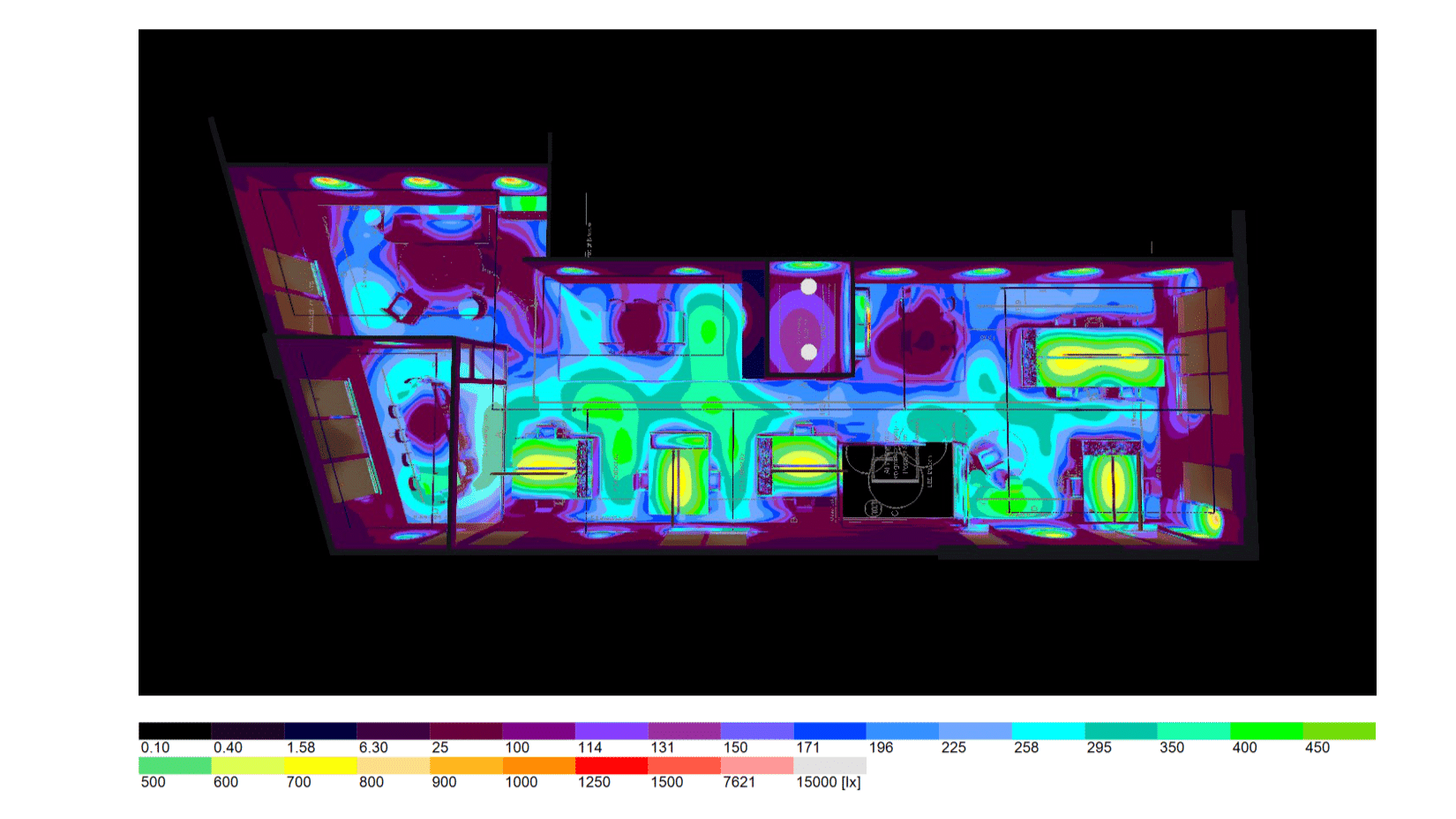
- Calculations of lux values, uniformity, glare rate(UGR), light distribution and possible energy consumption, among others.
So the result is not a guess, but a reasoned answer to questions such as:
- Is there enough light at workstations to the standard?
- Is the chance of glare limited?
- Is the lighting even enough, without dark corners?
- Does the light color match the function and atmosphere?
- How many fixtures are really needed?
- What does this mean for long-term consumption?
A lighting study helps you as a professional to make and substantiate choices based on data instead of feelings. This makes your design stronger and more defensible towards clients.
Why is a lighting study important?
For professionals who design, implement or supervise projects, a lighting study offers three major benefits. Quality, compliance and control.
Comfort and visual quality
A room can look great in a plan, but feel hard, flat or just dark in practice. With a lighting study, you can see in advance whether workstations are adequately and evenly lit. Whether people are not looking straight into the light source(UGR control) and whether there is a good balance between functional light and ambient lighting. This is important in all kinds of projects such as offices, schools, healthcare environments, retail, hospitality, industry and residential projects. Too little light leads to fatigue and mistakes, too much or poorly distributed light creates restlessness, glare and a lab atmosphere. A lighting study reveals these effects before construction or renovation.
Meeting standards and regulations
In professional environments, “it feels okay” is not enough. You have to deal with standards such as NBN EN12464-1 (indoor lighting of workplaces) and NBN EN12464-2 (outdoor and industrial environments) that set minimum light levels, uniformity and glare limits. These are guidelines for offices, schools, production halls and parking garages, among others. A lighting study demonstrates that the design meets the required lux values, takes into account maintenance factors (such as ageing and pollution) and that fixtures have been chosen and positioned correctly. This sends a strong signal to clients, prevention advisors and inspection bodies. The lighting design is not fingerwork, but is substantiated according to standards.
Energy, budget and long term
Lighting is a structural expense. Without a lighting study, you often see two extremes. First, overexposure, too many fixtures, excessive power and unnecessary consumption. Or underexposure, too little light, later replacement, extra costs and eventually complaints. With a lighting study, you calculate exactly how many fixtures are needed, which light sources and drivers are efficient, what the estimated energy consumption is, and which solutions will help to maintain future standards and comfort. Especially when combined with LED, smart controls and high LB values, a lighting study reveals how much you will save over 5, 10 or 15 years instead of just looking at the purchase price.
How does a lighting study proceed?
A good lighting study never starts from ‘we’ll hang some fixtures and see’. It arises from a well thought-out process in which technology, standards and perception come together. Especially in professional environments such as offices, retail, industry, healthcare and hospitality, a lighting study helps to make smart choices in advance instead of solving problems afterwards.
Intake and context
Everything starts with questions. What is happening in space? Who uses them? How long per day? What atmosphere do you want to set? Are there requirements from standards, welfare or brand identity? During this phase, we also map out the existing situation. Floor plans, heights, materials, existing lighting, daylighting and technical limitations. The more concrete the input, the better the lighting study. Would you like to request an exploratory meeting with Lixero? Contact us without obligation.
Visual and functional analysis
Then we look at function by zone. A landscape office requires something different than a conference room. A counter in a store needs different accents than a warehouse aisle. In this phase we determine, among other things, the desired lighting levels(lux values), distribution between basic light, accent light and possibly decorative light. In addition, focal points such as glare(UGR), light color(Kelvin), color rendering(CRI), reflections and contrast are determined. For our projects, we align this with relevant standards and guidelines. Here we translate everything into practice, what feels pleasant, safe and functional for the user and client?
Calculations and simulations
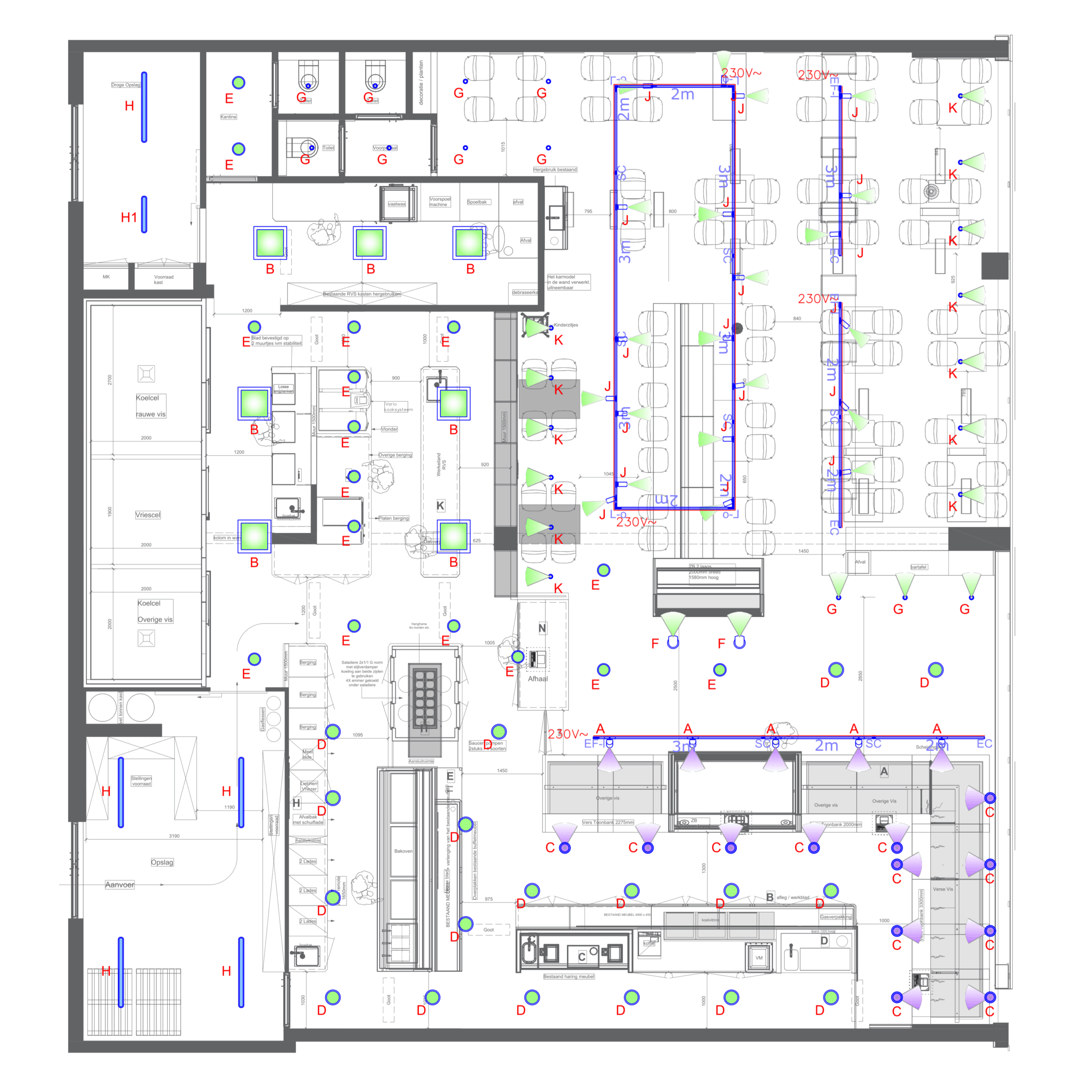
With the collected data and requirements we create a digital lighting study, for this we work with DIALux. In this we calculate how much light reaches the work surface, floor and walls and how even or contrasty the light is distributed. But also what the impact is of luminaire selection, positions, optics and light colors and whether the solution meets both technical requirements and visual expectations. We optimize fixture selection where possible, so fewer fixtures, with better efficiency (energy savings) and a better light experience. Without compromising on comfort or standardization. This is when you avoid surprises. Instead of ‘we hope it works out’, you see black and white whether a design is correct.
Report and substantiation
A professional lighting study ends with a clear report. This provides insight into positions, lux levels, light output and consumption including visualizations and possible substantiation towards building management, architect or (end) client. In this way, a lighting study is not a theoretical document but a useful working document that reduces risks and increases quality.
In practice
As you now know, a lighting study is not a luxury product. It is a practical tool that offers direct added value in many different sectors. And that’s exactly where the power lies for professionals.
Lighting study for offices
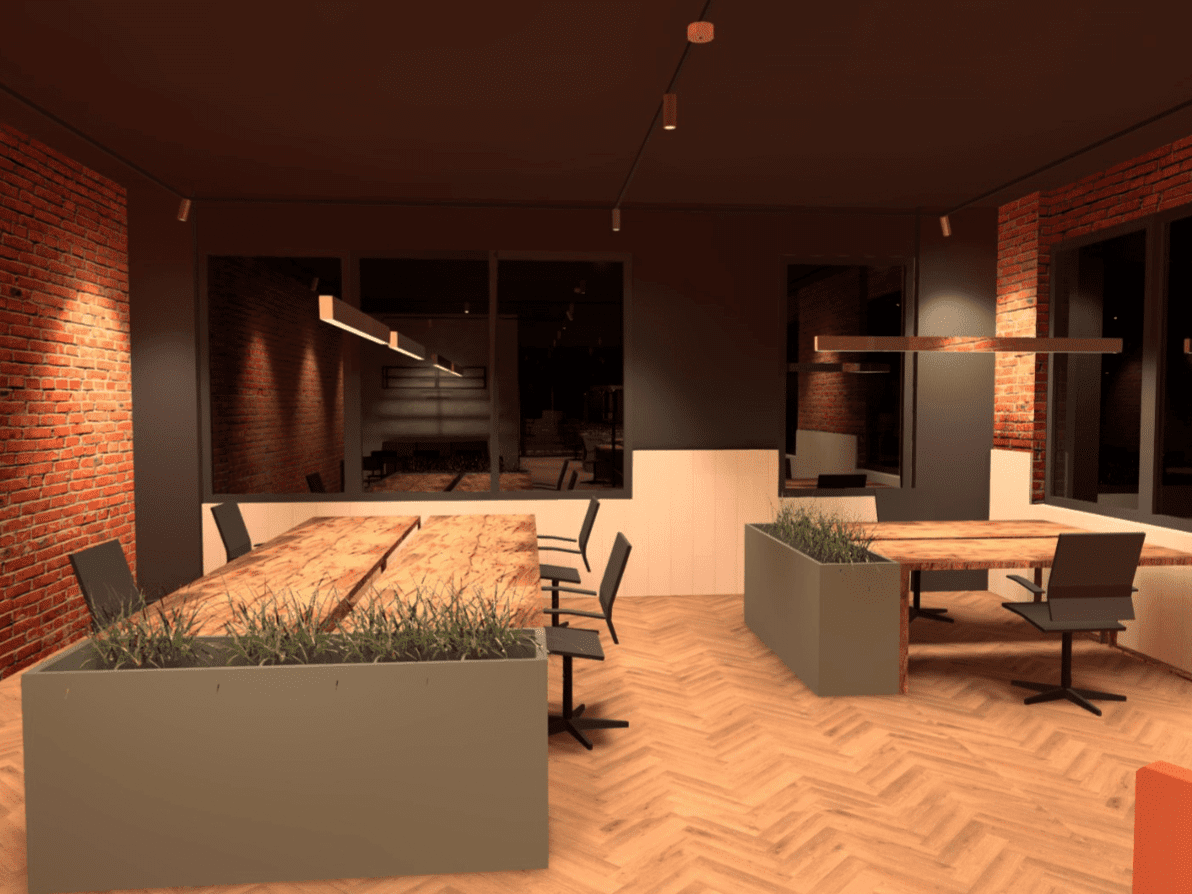
An office lighting study quickly runs into familiar problems. Too little light at workstations, too much contrast with outside light, disturbing glare from screen reflections or fixtures that “sting in the eyes. With a lighting study you test whether the light levels meet the guidelines for office workplaces. Prevent the light level from falling below the desired lux standard after a few years, for example due to luminaires with low LB values. And combine visual comfort, energy efficiency and appearance.
For example: An open office in Antwerp with lots of daylight on the facade and dark areas in the middle. A lighting study shows where to add indirect light, where to make fixtures dimmable and how to reduce glare. The result is fewer complaints, better concentration and a longer life of the installation. Want to know more about how to provide healthy lighting in an office? Read it in our article.
Lighting study for retail and hospitality
In stores and restaurants, it’s all about experience, routing and presentation. Too bright light makes a space chilly, too little light makes products and details disappear. A lighting study helps to emphasize what is important, such as products, displays and tables. Make a good combination between general lighting and ambient lighting. To correctly highlight shelves, fitting rooms and cash registers. And to avoid typical mistakes, such as white spots on the floor and dining tables that are too dark.
Example: A fashion store in the heart of Ghent. With a lighting study, you match light color, CRI and accent lighting to the fabrics and materials. You make sure the fitting rooms have flattering light and that the window stands out and draws people in, without blinding passersby.
Lighting study for industry and logistics
In production halls, warehouses and distribution centers, requirements are higher in terms of safety, reliability and maintenance. High mounting heights make replacing fixtures expensive and complex. A good lighting study ensures sufficient light in work areas, driving routes and racking. It also helps you avoid shadows in aisles and on labels and helps you choose robust fixtures with good LB values and high efficiency. Finally, in a lighting study you integrate emergency lighting, sensors and lighting control.
For example: A warehouse 12 meters high, here the study shows that quality high bays with a high LB value (more expensive to buy) are cheaper in the long run than a cheaper solution with faster light loss, additional fixtures and more frequent replacement.
Lighting study for (residential) care
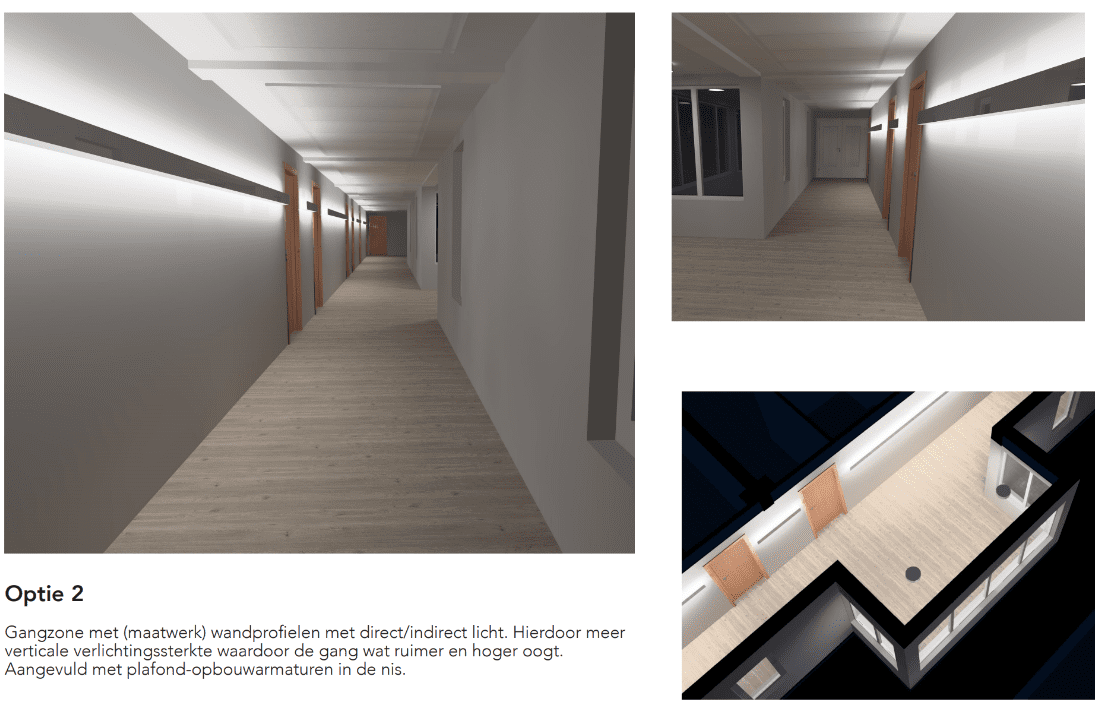
In assisted living facilities, assisted living or other care environments, the focus is on safety, recognizability and quality for residents who need extra attention. A lighting study takes into account higher light levels in “traffic zones” and living areas, limiting glare and annoying reflections. But also soft transitions between light and dark and recognizable quiet lighting around rooms, bathrooms and any night hazards. This prevents fall risks, disorientation and restlessness and improves quality of life.
Lighting study in education and public buildings
In schools, libraries and other public buildings, lighting should be versatile. Learning, working, presenting and meeting in one building. With a lighting study you tune the light to different activities, ensure good reading and teaching conditions without eyestrain, integrate dimmable solutions that add value, and take into account sustainability and total cost of ownership.
Technical basis of a lighting study
A lighting study sounds creative, but at its core it’s also hard math. In this chapter, we’ll magnify through the key technical terms that appear in every professional lighting study. That way you’ll know exactly what’s behind the numbers and colorful visualizations.
Lux (illuminance)
The basis of any lighting study is illuminance, expressed in lux (lx). This indicates how much light reaches a given surface, such as a desk, counter or work table. In a lighting study, the designer not only calculates the average lux level, but also whether those values remain achievable over time. This is done with a maintenance factor, which includes pollution, aging and LB values. This avoids the project having “just enough” upon completion and then falling below standard a few years later.
Examples:
– Office: typically 500 lux on the work surface
– Meeting room: 300 to 500 lux
– Retail: 300 to 1000 lux, depending on zone and experience
– Warehouse aisles: 150 to 200 lux, order pick zones often higher
Evenness
Not only the amount of light counts, but also how evenly that light is distributed. We call this uniformity. A room with 500 lux in the center and 120 lux in the corners quickly feels restless and unprofessional. A lighting study therefore looks at the ratio between minimum and average lux to avoid dark zones, especially along walkways, walls and workstations. For offices, schools and other professional environments, good uniformity is essential for comfort, safety and a calm impression.
UGR (glare)
Too bright light, glaring spotlights or visible light points cause glare. This leads to eye squinting, fatigue and, at worst, complaints from users or customers. This is why a lighting study often calculates the UGR value. This value indicates how disturbing the lighting can be in a certain viewing direction. The guideline for offices, according to EN 12464-1 is UGR <19 at workstations. In a good lighting study, one chooses fixtures, positions and optics that direct light rather than allowing it to shine in the face.
CRI and TM-30 (color rendering)
Light affects how materials, products, shades and signage look. This is where color rendering plays a key role. The Color Rendering Index (CRI) dives out how true-to-life colors appear compared to reference light. For professional applications, CRI >80 is often the minimum. But in retail, healthcare, hospitality and high-end offices, CRI >90 is highly recommended. There is also the TM-30, a more modern method that incorporates more colors and nuances than just CRI. Especially relevant for projects where color criticality work takes place or brand identity is very important. A lighting study verifies that the chosen fixtures provide sufficient color quality for the function of the space. After all, a fashion store with many different colors of clothing expects something different than a stockroom filled with boxes.
Kelvin (color temperature)
The color temperature (in Kelvin) determines whether light feels warm, neutral or cool. In a lighting study, each zone considers what color temperature best suits: 1. the function, for example, working or relaxing, waiting or buying. 2. the interior, with the materials, colors but also daylight. 3. the desired experience, such as warm, businesslike, industrial or creative.
Commonly used color temperatures
- 2700K: Warm and cozy, widely used in hospitality and atmosphere zones
- 3000K and 3500K: Balance between ambience and functionality, widely used in retail
- 4000K: Fresh and bright, often in offices and sometimes in retail
- 5000K and above: Very cool, rather for specific technical environments
Lumens per watt (energy efficiency)
In a lighting study, you look not only at how much light is needed but also how much energy is required to do so. Here the following parameters are important: Lumen (lm) The total luminous flux of a luminaire. Watt (W)the power consumption of a luminaire. Lumen per watt (lm/W) the efficiency of lighting, the higher the better. Modern LED lighting combines high light output with low consumption. The study reveals the total system power, the expected energy cost and the savings. Thus, as a designer or installer you can make an informed choice between different solutions, in function of E-level, sustainability, TCO or certifications.
LB value (lifetime)
With the right lighting, you can move forward for years. That’s why we always consider long-term performance in a lighting study. Here, the LB value is an important parameter. The L value stands for lumen maintenance and indicates the percentage of the original light output that remains after a certain number of burning hours, for example L80 or L90. The B value indicates what proportion of the LEDs reach at least this level, for example 10%. For example, a luminaire with L80B10 >50,000h delivers 90% of the LEDs still at least 80% light output after 50,000 hours of burning. This is important for lifetime standards testing and maintenance planning, especially for luminaires placed in less accessible areas such as in a high hallway.

Common mistakes without a lighting study
A lighting concept based on feel or pretty picture sometimes seems tempting. But without a well-founded lighting study, errors quickly creep into the design. Mistakes that you only discover upon delivery, inspection or when users start complaining. We list the most common pitfalls so that you can avoid them in your project.
Choice based solely on looks or price
A slim profile, beautiful fixture colors and a competitive price. Luminaires often tempt visually or financially. But those who select solely on these factors miss the point. Without a lighting study you don’t know how much light the luminaire really provides on the work surface, whether you have enough luminaires for the space, whether the luminaires are efficient enough for your energy ambitions and whether you stay within the standards, both now and in a number of years. The upshot? Upon completion, everything seems okay, but in use the lighting turns out to be uneven, too weak or just too bright. A lighting study forces you to look beyond the price tag or the catalog photo and makes the translation into practice.
Too little attention to glare and reflection
Without calculated reflectance values and thoughtful positioning, glare situations often arise. Spotlights shining straight into the eyes at the reception desk, downlights above screens or pin machines causing reflections or fixtures with visible LED points above tables. Users experience this as “harsh light,” but the cause usually lies in a lack of preparation. A professional lighting study examines viewing directions, reflections on screens, shiny floors and glass areas. This is how you design light that is present without being overpowering.
No consideration of aging and maintenance
Unfortunately, many projects rely solely on initial light output. In practice, LEDs age, luminaires get dirty, surfaces discolor and spaces change. Without a maintenance factor in the study, you often start right at the standard limit and drop below the required limits within a few years. As a result, you have to replace or add on more quickly, which ultimately costs more. A lighting study integrates all of this into one calculation. This way you design for the entire life span and not just for the day of completion.
Illogical lighting images and unsettled spaces
A common symptom of design without study is a lighting image that does not match the space. For example, dark corners, walkways without clear guidance, overexposed areas next to atmospherically intended spots and ceilings full of randomly placed spotlights without rhythm. This looks unsettled, unprofessional, feels uncomfortable and detracts from architecture and interior design. In a lighting study you always look at the overall picture, i.e. light as part of the design, aligned with lines, volumes, materials and functions.
Conclusion
A good lighting study is not a luxury or an extra step “for the side,” but an important part of any professional project. It prevents underexposed workplaces, dazzling guests, energy waste, deviations from the norm and discussions afterwards. You substantiate your choice with figures instead of feelings and show clients and users that you have thought about it.
For you as an architect, (interior) designer, lighting designer or installer, this means peace of mind in the process. You use the lighting study as a technical and visual compass. It helps you coordinate materials, fixtures, budget and atmosphere. And you tackle future problems at plan level. No surprises on delivery, no extra rounds because the light ‘feels different’.
Your light study, our expertise
At Lixero, we work this way every day. Our own design department makes lighting studies for offices, retail, industry, hospitality, healthcare, education and residential projects. Tailored to the reality of the space and the applicable standards. If you wish, we can seamlessly link the next steps such as support in product selection, delivery of quality luminaires and possible installation and adjustment.
In short, you design and realize. We make sure the light is right. Do you have a project on the table where you want to be sure the light is technically, visually and future-proof right? Please contact us without obligation.