





10 lighting trends for 2026
In 2026, the lighting industry continues to evolve at lightning speed. In an increasingly digital and conscious world, lighting plays an important role in how we experience spaces. With shaping our visual experience, influencing well-being and contributing to sustainability. People no longer see lighting as merely functional, but as a dynamic interplay of aesthetics, technology and environmental responsibility. Below we discuss the ten most prominent lighting trends for 2026. Each trend is explained with context, examples and, where possible, visual examples.
1. Light as an experience, almost as an art form
Whereas in 2023 we already saw that design lighting is increasingly gaining a permanent place in the overall concept, and in 2024 there was again room for real eye-catchers due to “less is more” thinking, 2026 goes one step further. Light becomes not just something you turn on, but something you experience. It adds tension with shadow, reflection and layering, and it can literally “make a space move” without needing much.
At trade shows like Light + Building, you see this very clearly in themes where magic and technology come together. Think of fixtures that play with reflections, subtle movement, an almost unreal glow and sensory effects. It’s not about hard spectacle, but about a cleverly designed light image that builds atmosphere and guides your gaze.
2. Human Centric Lighting
This trend has been with us for a few years. Back in 2023 we wrote about the focus on people, and in 2024 Human Centric Lighting really became a recognizable topic within projects. Meanwhile, in 2026, you see that it is less and less “extra,” and more and more a starting point. Especially in environments where people spend many hours at a time, such as office lighting, education and healthcare lighting
The bottom line is simple. Light does more than improve visibility. By allowing light color and intensity to move with the rhythm of the day, you make a space more pleasant to work, learn or recover in. A little cooler and more active during the day, warmer and quieter later in the day. In 2025 we already clearly named this as circadian lighting, and that line continues in 2026.
Important detail. This only works really well if you can also control it properly. That’s why you often see Human Centric Lighting coming together with lighting control. We link dynamic lighting to (wireless) controllable systems such as DALI and Casambi, so that you can dim and adjust per zone or per scene. Then it becomes not a trick, but a logical part of a customized lighting plan.

3. Connected lighting
Smart lighting is no longer a “new” trend. Back in 2023, we mentioned smart lighting as a clear development, with control via apps, voice and sensors. In 2024, that became more concrete with wirelessly controllable lighting and systems like DALI and Casambi. In 2025, the focus shifted to IoT integration and even AI in lighting. So in 2026, it’s safe to say that smart lighting is increasingly becoming the standard layer in a project, rather than an add-on.
What does change is the experience. The distinction is no longer in “can you control it with an app,” but in how unobtrusively it works. Less manual fine-tuning, more logic in the background. Think automatic adjustment based on presence, time of day and daylight. And scenes that match the use of the room. That suddenly makes lighting control not only a technical choice, but also a way to cleverly bring comfort and energy consumption together.
At trade shows, you also see that lighting systems are becoming increasingly data-driven. Not just dimming and switching, but also monitoring, adjusting and looking ahead. Think of sensors that help tune light levels, support well-being and plan maintenance. In retail, on top of that, you see applications where lighting dynamically moves with what is being presented. That’s exactly where AI lands in practice.
4. Modular lighting
In 2026, you will increasingly see lighting constructed from smart building blocks. Not because “modular” is a trendy word, but because spaces simply change. A store gets a new theme, an office changes layout, a hospitality concept changes with the seasons. Then you don’t want to start from scratch, but build on what is already there.
That line ties in nicely with what we mentioned earlier. In 2025, the demand for customization and a customized lighting plan clearly increased. Modular systems also make that customization practical. You design a basis that’s right, and you keep room to shift, expand or simplify later.
What we see at trade shows and in projects is that manufacturers are making this flexibility easier and easier. Think of track systems and click concepts in which you can change spotlights, pendants or linear modules without pulling open the entire ceiling. A track rail with well-chosen fixtures is a very logical example of this. You can move accents as the interior changes, without sacrificing the light image for tranquility and quality. And there is another advantage. Modularity also helps with sustainability. If you can adapt a system with components, you are less likely to need to replace them. That fits in with the movement that we have been seeing for some time towards smarter use of materials and lifespan.
In practice, then, it’s all about a lighting plan that grows with you. A strong base with basic lighting, supplemented with accent lighting in places that may change. And if you design it well, the whole remains true in atmosphere, balance and comfort even after adjustments.

Welkoop’s seasonal square changes 4 times a year. The track spots can easily be refocused on the items.
5. New approach to sustainability
Sustainability in 2026 is no longer something you “take with you when it comes out.” It is a precondition. And you can see this in the line of the past few years. In 2023, the focus was mainly on energy efficiency and “planet proof” choices. In 2024 it went a step further and circular lighting really came into the spotlight, focusing on reuse and raw materials that don’t end up as waste. In 2025, it was even more clearly articulated. Sustainability is no longer a trend, but a requirement.
What will be added in 2026 is that the conversation will become broader. It’s not just about economy, but also about material selection, production and longevity. You’ll see more natural and biobased materials popping up at trade shows, and designs made from waste streams. Not because it “has to feel green,” but because it’s simply smarter to keep materials in the chain longer.
That’s why you see more focus on remountable designs. Luminaires that you can open, repair and upgrade. Drivers and LED modules that are replaceable. And systems that you don’t have to write off after five years because one part fails. That way of thinking fits with how we look at it ourselves. Light must be able to last longer, and at the end of the ride you must be able to do something with it again.
For us, Yuugn is a great example of this. Circular luminaires that are 3D printed from recycled PETG, and which can be recycled again. And it’s exactly why we received the Green Plume in October 2025, in recognition of sustainable and social enterprise. We do not see this as an end point, but as confirmation that this course is right, and that we must continue to pursue it in design, production and the choices we make together with partners.
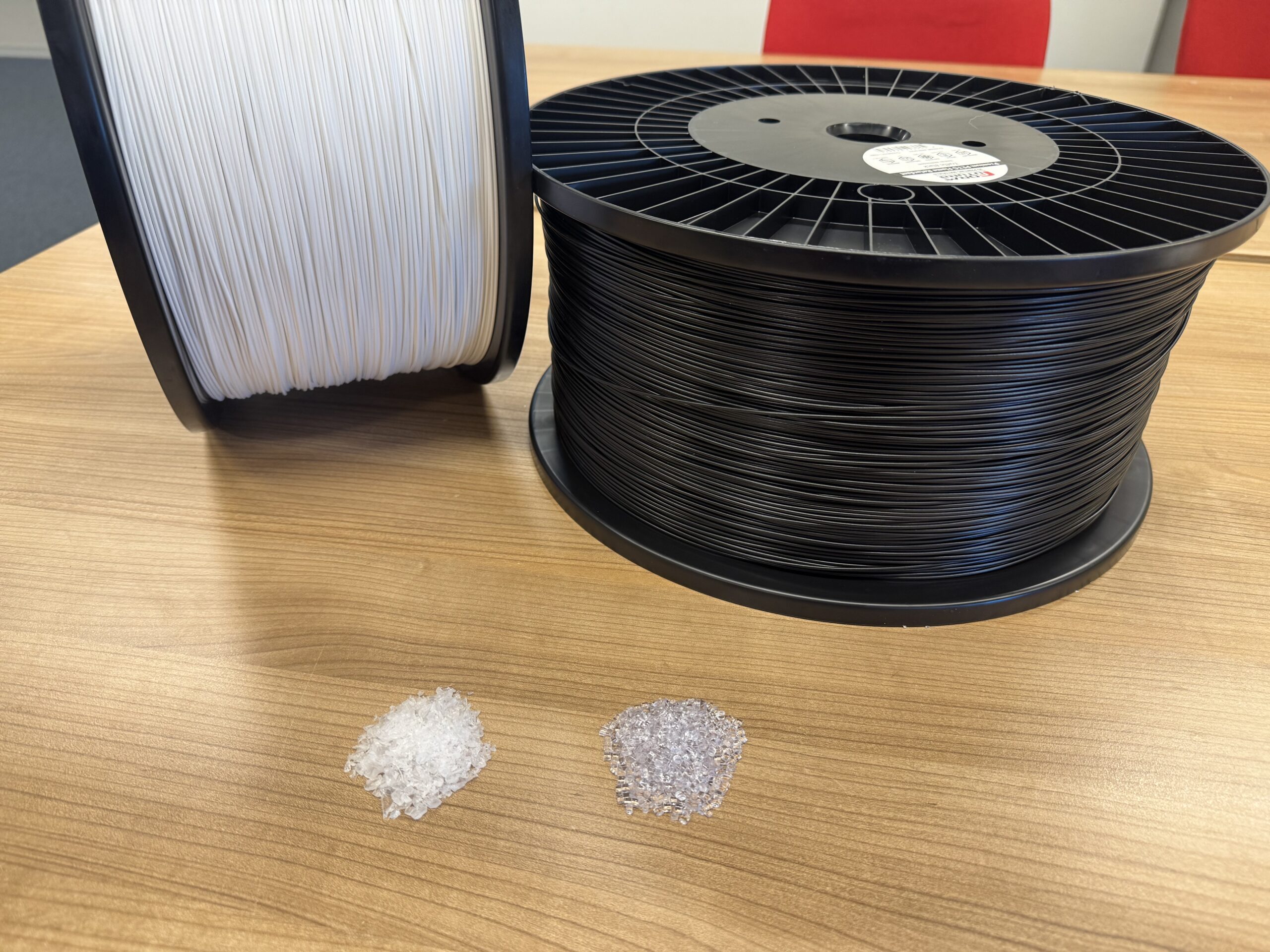
Circular raw materials for 3D printing our Yuugn fixtures.
6. The year of craftsmanship
This trend feels like a logical continuation of what we have already seen in recent years. In 2023, “design” was clearly more than just functional, and in 2024, less is more actually created space for one distinct fixture to really work. In 2026, you’ll see many designers combining that quietness with materials where you can still see the craftsmanship. Think textured glass, ceramics, woven textures, metal with patina, and fixtures that just don’t want to be perfect. That’s exactly what makes them interesting.
At fairs such as Euroluce, this was also strongly evident in collaborations between designers and makers. Porcelain, mouth-blown glass and textile techniques are not hidden but rather used to create a softer light image and more layering. The result is lighting that not only “fits,” but also adds something to the story of the space. In the process, you’ll also see more heritage chic in 2026. Classic shapes and vintage fixtures are returning, often with modern technology behind them. The nice thing is that this goes very well with a sleek interior. Especially if the base is quiet, one lamp is allowed to have character.
What helps in practice is the same thought that goes into a good lighting plan. You build a solid base lighting first, and then you pick one or two spots where you put a fixture as a statement. Then it stays comfortable and the experience is right, without being crowded.

7. Statement lighting
We have actually been seeing this trend build up for a few years. In 2023, decorative lighting emerged more clearly as part of the interior design concept. And in 2025 we saw how important layered lighting is to make such a statement actually work. In 2026, we reached the point where lighting is more often deliberately “allowed to stand out.” Not as noise, but as a design choice.
What you see a lot of are fixtures that hang almost as objects in space. Large in scale, sculptural in shape, sometimes with unexpected materials or a striking finish. Think of a pendant light that arranges the lobby or dining table, or a fixture that literally marks the center of the concept. This works especially well if the rest of the plan is quiet. Then such an eye-catcher feels like a logical anchor point, rather than a loose addition.
That combination is typical 2026. On the one hand, statement pieces. On the other, subtle integration, such as line lighting and LED strips that give the architecture just a soft glow, for example along walls, in a cove or behind a headboard. With a sleek base light and well-placed accent lighting, make room for one lamp that tells the story, without sacrificing comfort or light levels.
It’s also broadening in terms of appearance. Besides black and minimalism, you’ll see more color, more playful shades and finishes that add character. And design classics are returning in a modern guise, with LED and sometimes even wireless. That makes it easier to add a touch of nostalgia without compromising on technology and use.
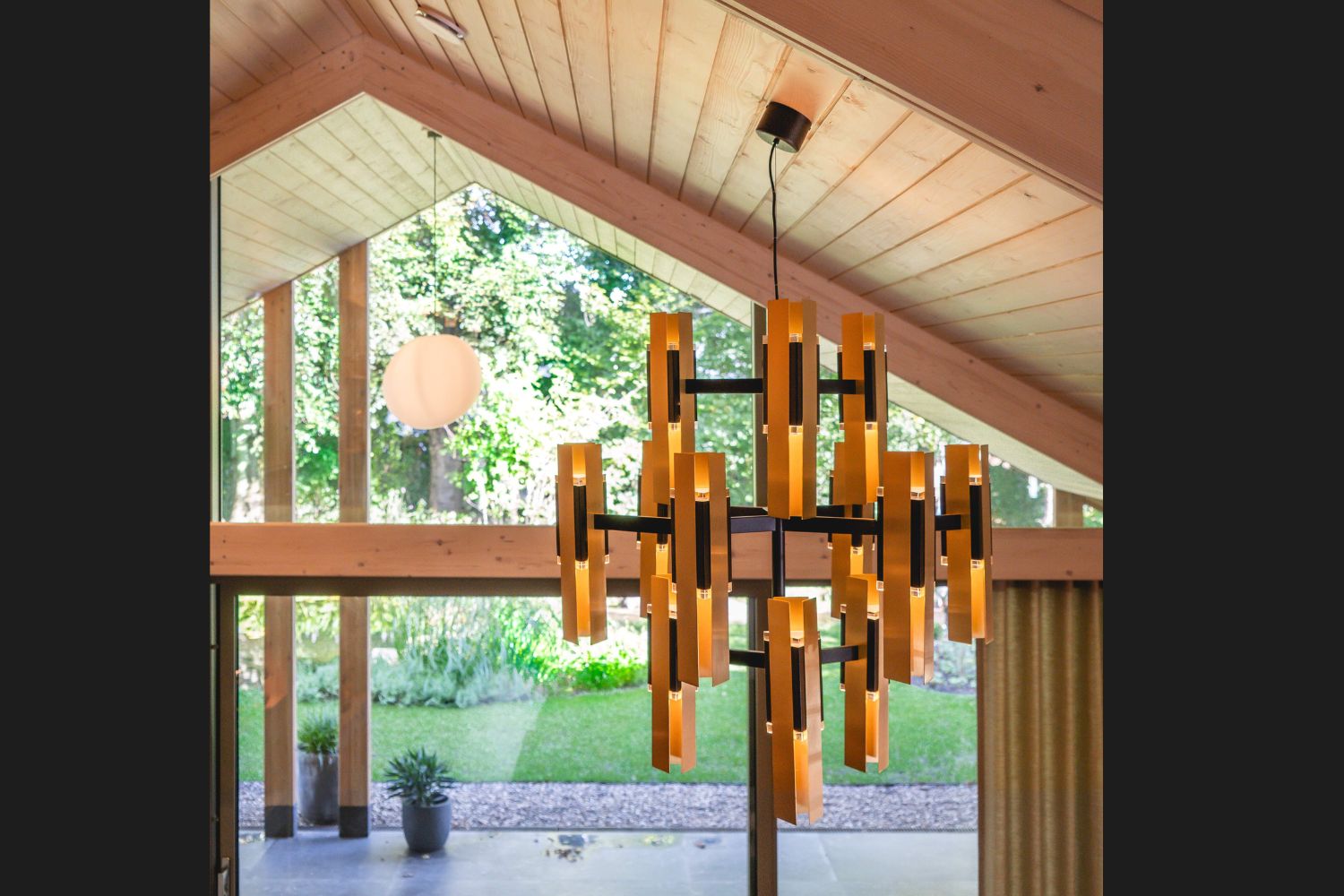
8. Invisible light
Minimalism will remain a strong foundation in 2026, especially in architecture and high-end interiors. Only it is no longer about “as few fixtures as possible,” but about “as little visual noise as possible.” The light is there, but the fixture disappears into the background. You see mostly the effect, not the technology. You see this in the growth of line lighting and soft glow lines. LED strips in cove frames, under furniture, along stairs or baseboards that give a room just a little more depth. This kind of lighting makes architecture readable, and it also works practically as orientation in the evening or at night.
In addition, integration is getting tighter. Trimless recessed spotlights, minimalist downlights and microspots that disappear into ceiling and wall. Especially in combination with good optics and shielding, so that you experience the light pleasantly and do not look into the source. This is where technology comes in, but in a way that supports the design. Think low UGR values, flicker-free dimming and fixtures that stay beautiful down to very low levels.
What we also see more often is honest use of materials and finishes that blend in. No striking edges or shiny accents, but quiet colors and shapes that match the interior. At trade fairs such as Light + Building, this was already established as a clear direction. Not lavish, but well thought out. In practice, this trend works best as part of a good lighting plan. You consciously choose where light can disappear and where you want to place accents on material, art or routing. Then the space remains calm, while the light image is exciting enough to carry atmosphere and function.
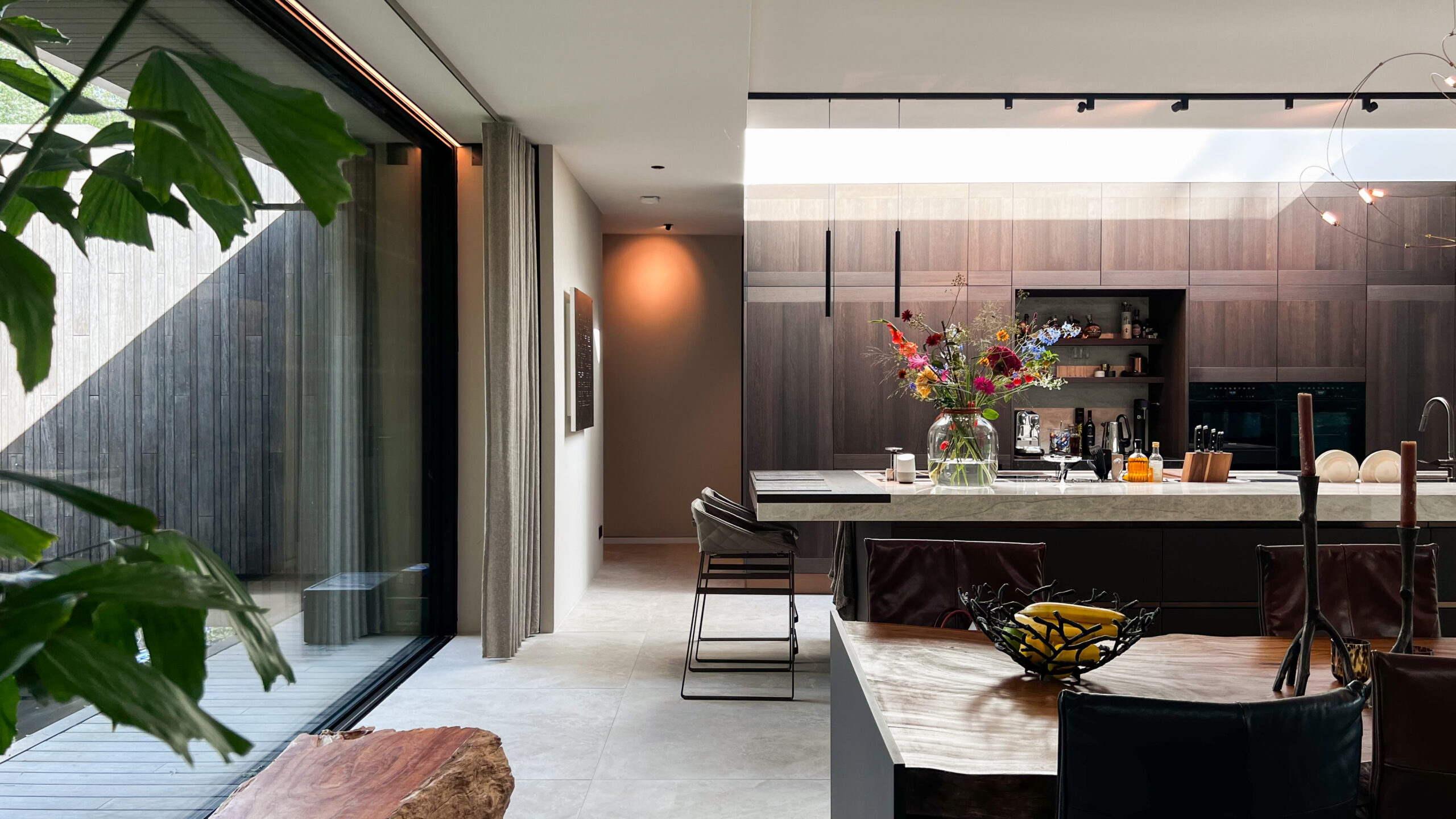
LED strips nicely concealed in the cove.
9. Inside becomes outside
Outdoor spaces will increasingly be designed as a full part of the overall concept in 2026. Terrace, patio, roof garden or garden room. It is no longer “there should be another lamp outside,” but “how does this place feel in the evening.” As a result, outdoor lighting is shifting from purely functional to a combination of atmosphere, comfort and smart control.
You see indoor trends are going one-for-one with the outdoors. Decorative fixtures that you could just as easily use indoors. Dimmable light to control the atmosphere. And smart links with daylight and presence, so that it’s automatically right when you sit outside, and also when you go inside.
Technically, more is also expected. Weather resistance is basic, with fixtures designed for rain, wind and UV. As a result, you see an IP65 or higher more often as a starting point. And light pollution is also getting more attention. More directed downwards, less stray light and timetables that automatically dim or switch off when really not needed. This is pleasant for the environment, and it fits in with the broader movement toward being more energy-conscious. In this way, outdoor lighting not only becomes more beautiful, but also easier to use.
10. Portable and multifunctional lamps
Portable lighting is here to stay in 2026. Rechargeable table lamps and wireless floor lamps make it easy to create atmosphere without having to think about outlets and cables first. You put the light where you need it, and you move it with you just as quickly. Indoors, outdoors, at the table, on a sideboard or on the terrace.
What you see most of all is that these lamps have come of age. They are no longer “handy gadgets,” but serious design objects that really add something to a room. With multiple light modes, dimmability and sometimes even a warmer evening mode that feels quieter. In hospitality, this works perfectly because you can quickly create atmosphere per table, and also because you remain flexible outside without fixed connection points.
Multifunctionality plays into this. Some designs combine light with an additional function, or are designed to be a decorative object during the day and take on their role as a light maker in the evening. This fits with how we look at spaces in 2026. Furniture and fixtures should not only be beautiful, but also move with use. There is a caveat, though. Battery life and light output must match the application. For intimate ambience, it is often perfect, but for truly functional work light, fixed lighting usually remains the base. That’s why portable light works best as a supplement.

Lighting trends 2026
The lighting world of 2026 is characterized by a rich interplay between aesthetics, technology and sustainability. From abstract lighting experiences and health-focused lighting to intelligent systems and artisanal showpieces. Each trend responds to the changing needs of a demanding audience that is both technically and creatively savvy. Innovations shown at trade shows such as Light + Building and Euroluce confirm that lighting design is becoming increasingly holistic. It connects form with function, emotion with efficiency. For professionals, this means an exciting time when innovation is the norm. These ten trends offer guidance and inspiration to create environments that are not only well-lit, but also meaningfully illuminated. So with consideration for people, the environment and beautiful designs.