





What is DALI lighting?
In modern offices, stores and commercial buildings, you want light that does more than just turn on or off. You want lighting that moves with the use of the space, contributes to comfort and helps reduce energy consumption. DALI lighting gives you that control.
DALI is a digital lighting control system that allows you to control each fixture individually. This allows you to easily adjust light levels, scenes and sometimes even color temperatures. In this article, we explain what DALI lighting is, how DALI control works, its benefits and in which projects it adds extra value.
What exactly is DALI control?
DALI stands for Digital Addressable Lighting Interface. It is an international standard for lighting control supported by several lighting manufacturers. That means luminaires, drivers, sensors and control panels from different brands can work together in one DALI system.
A DALI system roughly consists of three parts: a DALI controller, the DALI bus and the DALI fixtures and components. The controller sends digital signals over the DALI bus to the connected devices. Each fixture has its own address and can therefore be controlled individually.
DALI as an open standard
Because DALI is an open standard, you are not tied to one brand. So in a project, different types of fixtures, drivers and sensors can be combined, as long as they speak DALI. That makes the system flexible and more future-proof. You can more easily replace or expand fixtures later without having to rebuild the entire installation.
How does DALI lighting work in a building?
In a DALI system, each fixture or device is given a unique address. Up to 64 DALI devices can be connected to one DALI line. Within that line, you can group fixtures, for example, by office zone, conference room or corridor.
You can:
- Controlling individual fixtures
- Controlling groups of fixtures simultaneously
- Save scenes, e.g. for cleaning mode or evening mode
This allows you to adjust the complete lighting situation in a room at the touch of a button or via a building management system.
DALI-2
In addition to the original DALI standard, there is DALI-2. This version offers more extensive features and better inter-brand compatibility. Among other things, DALI-2 adds more capabilities for sensors and control panels.
In practice, that means:
- Presence and daylight sensors that communicate directly on DALI
- More ways to link DALI to a building management system
- A more stable and testable ecosystem of products
As a result, many new projects opt for DALI-2 components.

Benefits of DALI lighting for businesses
DALI lighting provides several benefits in business environments. These include energy savings, lighting plan flexibility, easier management and smarter maintenance.
1. Saving energy with DALI control
With DALI control, you regulate lighting in a smart way. Luminaires can automatically dim when there is enough daylight coming in or when no one is in a room. This way, you never burn more light than necessary and reduce energy consumption.
A practical example is Keurslagerij van der Meer. In this store, the lighting is automatically dimmed when no customers are present. This provides up to 80 percent savings on lighting consumption and ensures that products spoil less quickly. A clear example of how smart DALI control directly saves money and quality.
Wondering what smart LED lighting can do for your business? Contact us without obligation and discover the possibilities.
2. Flexible lighting plan
Business spaces are constantly changing. Workstations shift, store layouts change, and warehouses grow with inventory. With a traditional system, that often means a lot of conversion work on lighting.
With DALI lighting control, you can regroup fixtures and adjust scenes in the software without having to completely rewire. That makes DALI very suitable for organizations that regularly remodel or change their fixtures, such as offices, retail concepts and educational institutions.
3. Central control
DALI interfaces well with modern building management systems. Lighting is then one part of a broader control of the building, along with climate, shading and security.
For larger offices, department stores and healthcare facilities, this provides benefits:
- One central place where you set scenarios
- Better understanding of actual room usage
- Easy management across multiple floors or locations
For example, you can set an evening mode for the entire building or use a dashboard to see where lights are still on outside working hours.
4. Smart maintenance
Because DALI is a two-way system, the system can not only send commands but also receive information back from the fixtures. Faults and defective fixtures therefore become visible more quickly.
This saves time looking for the cause and makes maintenance more predictable. Instead of acting only when complaints arise, you can proactively plan maintenance and prevent breakdowns.

DALI lighting in practice
DALI control is used in a variety of environments. From office and retail to industry, education and healthcare. Below we explain some common applications.
DALI in offices
In offices, DALI lighting helps to optimize working comfort and energy consumption, for example:
- Workstations where employees can adjust light intensity within a bandwidth of their own
- Meeting rooms with scenes for presentations, brainstorming sessions or video calling, for example
- Daylight control along the façade so that fixtures dim automatically
DALI also helps prepare offices for energy labeling and sustainability requirements. Want to take a closer look at this? Read more about energy savings and lighting standards in the workplace in our white paper on office lighting.
DALI in stores and retail
Stores are all about experience and presentation. DALI makes it possible to create different light images per zone. For example:
A striking off-hours window scene
Quieter light in aisles
Extra accent light on promotions and seasonal presentations
Scenes also allow you to easily switch between a daily mode, for example, and a special mode for events or shopping nights.
Do you doubt whether your store lighting still suits the formula and the current assortment? With our free lighting check for stores, we look at it with you and give you concrete points of improvement.
DALI in industry and warehouses
In industrial environments and warehouses, safety plays a key role. DALI lighting can be linked to sensors so that light is lit only where it is needed, for example in aisles where movement is detected.
This results in two things:
Improved visibility and thus increased safety in the workplace
Lower energy consumption in rooms that are not in constant use
Want to know how much your company can save with smart LED lighting and DALI control? Contact us without obligation and we will calculate it for you.
DALI in schools and healthcare environments
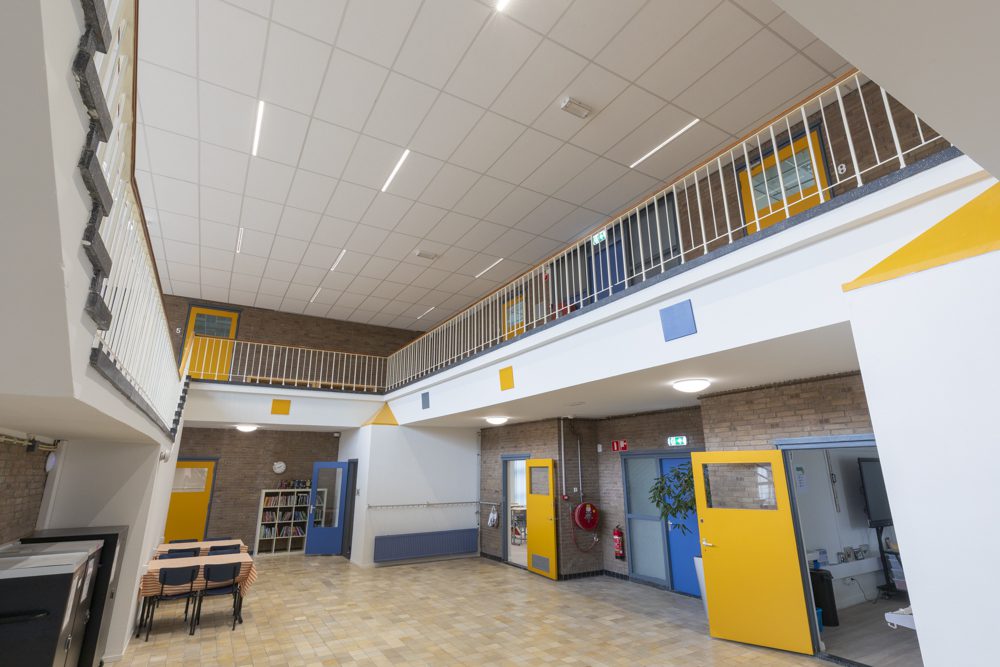
In schools and healthcare facilities, spaces are used for a variety of activities. From classroom lessons and individual concentration to consultation, care moments and relaxation.
With DALI lighting, you can match lighting scenes to use:
Bright, even light during classes or work moments
Softer lighting for presentations or relaxation
Different settings per classroom or department
This creates an environment that feels comfortable for students, staff, clients and visitors.
When do you choose DALI lighting?
DALI lighting is not necessary in every project, but it is very valuable in many business environments. In practice, we see that DALI becomes especially interesting when:
- It is a medium to large building
- You want to be able to centrally control multiple zones or rooms
- There are ambitions around energy conservation and sustainable management
- The layout of rooms changes with regularity
- You want to link lighting to other building functions
For smaller spaces or simple applications, a stand-alone solution can sometimes be sufficient. Do you doubt which form of lighting control suits your project? Then we would be happy to think with you based on the floor plan and the user’s wishes.
Frequently asked questions about DALI lighting
What is DALI lighting in one sentence?
DALI lighting is a digital system that allows you to control, group and incorporate each fixture individually into scenes, allowing you to precisely control the light in a building.
What is the difference between DALI and DALI-2?
DALI-2 is the further development of the original DALI standard. It offers more extensive testing procedures and more possibilities for sensors and control panels, among other things. Therefore, DALI-2 components are often chosen in new projects.
How many fixtures can I connect to one DALI line?
A maximum of 64 DALI devices can be connected to one DALI line. Larger projects use multiple lines that are controlled centrally or per floor.
Can I convert existing fixtures to DALI?
In some cases it can be done, for example by replacing drivers, but that depends on the type of luminaire and the existing installation. But in many projects, new DALI-compatible luminaires are chosen when renovating or preserving.
Do I need a building management system for DALI?
No. DALI can work stand-alone with a simple controller or control panel. In larger buildings, DALI is often paired with a building management system for additional insight and central control.
Have DALI lighting designed by Lixero
DALI is a powerful system, but it starts with a well thought-out lighting plan. Every day, our team helps installers, architects and companies design and realize projects with DALI lighting.
Based on your needs, we support you with such things as:
- A lighting plan that takes into account usage, standards and energy goals
- Choosing appropriate DALI luminaires.
- Linking with sensors, controls and possibly a building management system
Want to know what DALI lighting can do for your project? Check out our fixtures with DALI control or contact our team. We are happy to think with you, from initial sketch to working installation.